
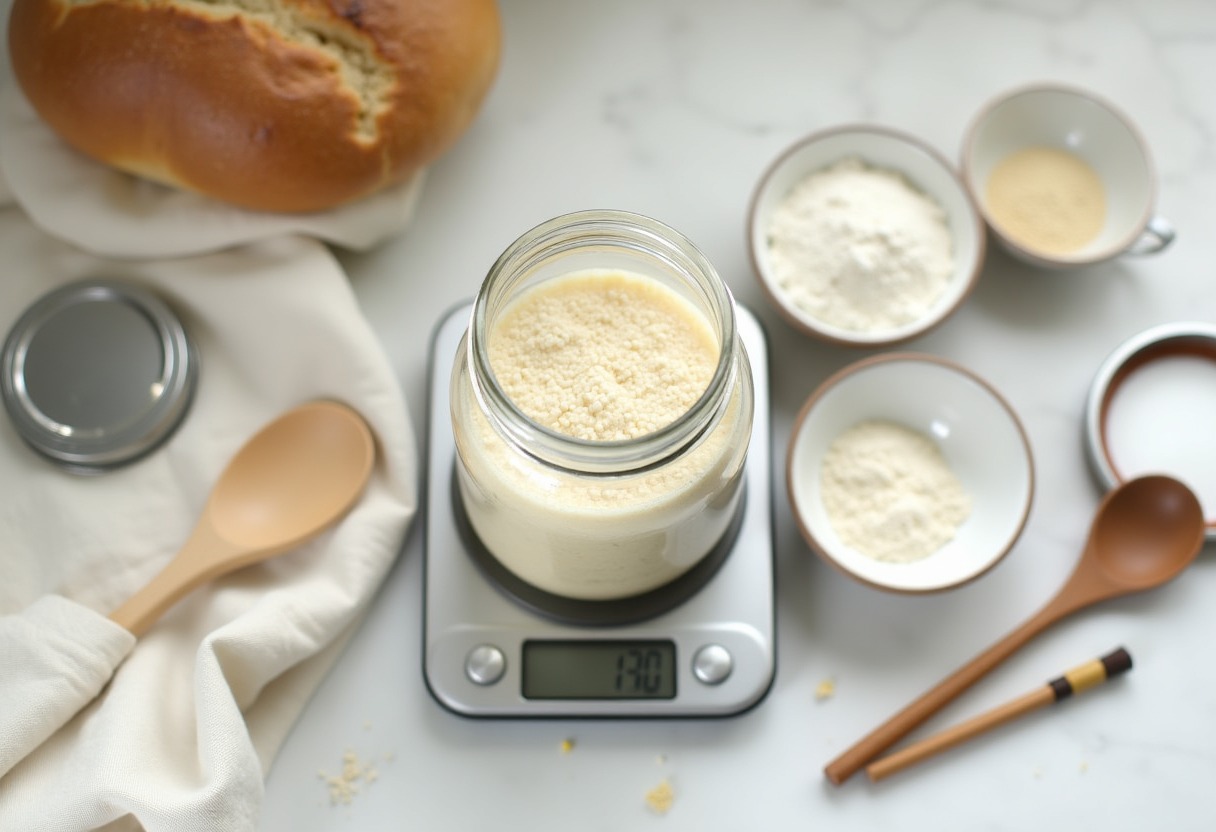
Your sourdough starter's feeding ratio determines everything from peak timing to bread strength. Most bakers stick to 1:1:1 without understanding that adjusting these numbers transforms starter behavior, discard volume, and fermentation speed in ways that can solve persistent baking problems.
Why Feeding Ratios Matter More Than Most Bakers Realize
Sourdough starter feeding ratios represent the weight relationship between existing starter, fresh flour, and water. A 1:1:1 ratio means equal weights of each component, while 1:2:2 doubles the flour and water relative to the starter. According to King Arthur Baking's fermentation research, these ratios directly control microbial population density, fermentation speed, and acid production.
The ratio you choose affects three critical factors: peak timing (when your starter doubles), acid levels (which influence flavor), and discard volume (which impacts waste). A weak starter struggling to double might need a higher flour ratio to feed its microbes adequately, while an aggressive starter might benefit from a lower ratio to slow fermentation for schedule flexibility.
Temperature amplifies ratio effects. A 1:5:5 ratio at 78°F produces drastically different results than the same ratio at 68°F, with peak times varying by 4-6 hours. Understanding this relationship prevents the frustration of missed peaks and failed bread timing.
The Core Feeding Ratios Every Baker Should Master
1:1:1 Ratio (Equal Parts) This foundational ratio works for daily feeding schedules and mild flavor preferences. Mix 20g starter with 20g flour and 20g water. Peak occurs within 6-8 hours at room temperature (70-72°F). Use when maintaining starter daily or building strength in newly established cultures.
1:2:2 Ratio (Double Flour and Water) Perfect for twice-daily feeding or building starter volume for large baking sessions. Combine 20g starter with 40g flour and 40g water. Peak extends to 8-12 hours, offering more scheduling flexibility. The increased food supply supports robust fermentation while moderating acid development.
1:3:3 and 1:5:5 Ratios (Extended Feeding) These ratios suit weekly maintenance or cold-weather baking when fermentation slows naturally. A 1:5:5 ratio (10g starter, 50g flour, 50g water) can peak in 12-24 hours depending on temperature and starter maturity. Higher ratios produce milder flavors and reduce feeding frequency.
Troubleshooting Ratios Weak starters benefit from 1:1:1 or even 2:1:1 ratios temporarily, concentrating microbes for faster recovery. Overly acidic starters respond well to 1:3:3 or higher ratios, diluting acid while providing fresh nutrients.
Feeding Ratio Comparison Table
| Ratio | Peak Time (72°F) | Feeding Frequency | Flavor Profile | Best For | |-------|------------------|-------------------|----------------|----------| | 1:1:1 | 6-8 hours | Daily | Tangy, pronounced | New starters, daily baking | | 1:2:2 | 8-12 hours | Every 12-24 hours | Balanced acidity | Regular maintenance | | 1:3:3 | 12-16 hours | Every 24-48 hours | Mild, less acidic | Busy schedules | | 1:5:5 | 16-24 hours | Weekly | Very mild | Long-term storage |
Essential Tools for Accurate Ratio Feeding
Precise measurements separate successful ratio feeding from guesswork. → Shop digital kitchen scales on Amazon that measure to 0.1g eliminate ratio errors that compound over multiple feedings.
The right container matters for ratio success. → Shop sourdough starter containers on Amazon with wide mouths and measurement markings help track starter growth patterns across different ratios. Our 2026 03 28 Best Sourdough Starter Jars guide covers container selection in detail.
→ Shop bench scrapers on Amazon make clean starter removal easier when working with small amounts for high ratios. → Shop measuring spoons set on Amazon provides backup measurement options, though scales remain more accurate for consistent results.
Mixing requires proper tools for complete incorporation. → Shop glass mixing bowls on Amazon offer non-reactive surfaces that won't interfere with starter chemistry, especially important when building large quantities for weekend baking sessions.
Advanced Ratio Strategies Most Guides Skip
Temperature-Adjusted Ratios Cold kitchens (65-68°F) benefit from lower ratios (1:1:1 or 1:2:2) to maintain reasonable peak times, while warm environments (75-80°F) handle higher ratios (1:4:4 or 1:5:5) without excessive speed. Track your starter's peak timing across seasons and adjust ratios accordingly rather than fighting temperature with heating mats or refrigeration.
Flour Type Ratio Modifications Whole grain flours ferment faster than white flour, requiring ratio adjustments. When feeding with 100% whole wheat, increase ratios by one step (1:1:1 becomes 1:2:2) to prevent over-fermentation. Rye flour, particularly aggressive, often needs 1:3:3 or higher ratios to maintain control.
Pre-Baking Ratio Planning Build starter strength 2-3 days before big baking sessions using decreasing ratios: start with 1:5:5, move to 1:2:2, then finish with 1:1:1 for maximum activity. This technique, borrowed from commercial bakeries, ensures peak starter performance when you need it most.
Discard Management Through Ratios High ratios generate more discard but create stronger starters. Low ratios minimize waste but may weaken starter over time. Balance these needs by alternating: use 1:1:1 for three days, then 1:3:3 for one day to manage discard while maintaining strength. Our Sourdough Discard Guide covers creative uses for excess starter.
For bakers interested in fermentation principles, consider exploring other cultured foods. The fermentation techniques in RawRootsLife's fermentation starters guide demonstrate how ratio principles apply across different microbial cultures.
FAQ
What happens if I use the wrong feeding ratio for my starter? Wrong ratios won't kill your starter but will throw off timing and flavor development. Too low ratios (like 1:1:1 in warm weather) create overly acidic, weak starters that peak quickly then collapse. Too high ratios (1:5:5 for new starters) may not provide enough microbial concentration for reliable doubling. Monitor your starter's peak behavior and adjust ratios gradually—one step up or down at a time—until you achieve consistent 6-12 hour peak windows that fit your schedule.
How do I calculate feeding ratios when I need different amounts of starter? Use the ratio as a formula, not fixed amounts. For 1:2:2 ratio producing 200g total starter, divide 200 by 5 (1+2+2) to get 40g base units: 40g existing starter + 80g flour + 80g water. For 300g total at 1:1:1, divide by 3 to get 100g each component. Always weigh ingredients rather than using volume measurements, as flour density varies significantly between brands and types.
Can I change feeding ratios suddenly or do I need to transition gradually? Sudden ratio changes work fine for healthy, established starters over 2 weeks old. Your microbial population adapts within 1-2 feedings to new food availability. However, weak or newly created starters benefit from gradual transitions—move from 1:1:1 to 1:2:2 to 1:3:3 over several days rather than jumping directly to 1:5:5. This prevents shock that could slow recovery in already struggling cultures.
Why does my starter peak at different times with the same ratio? Temperature fluctuations cause the most dramatic timing variations—a 5°F change can shift peak timing by 2-3 hours. Flour age and type also affect fermentation speed; fresh flour ferments faster than older flour, and different protein levels change microbial food availability. Seasonal humidity changes, starter age, and even water mineral content influence timing. Track patterns over weeks rather than expecting identical performance daily, and adjust ratios seasonally for consistency.
Should I use different ratios for different types of bread? Match starter strength to bread requirements rather than changing ratios for different recipes. High-hydration breads like sourdough with 80%+ hydration need very active starters built with lower ratios (1:1:1 or 1:2:2) for maximum lift. Dense, whole grain breads work well with milder starters from higher ratios (1:3:3 or 1:4:4) since the grains provide additional flavor complexity. The key lies in timing your final feeding to hit peak activity when you begin mixing, regardless of the recipe style.
Master your starter's ratio sweet spot, and you control every aspect of your sourdough journey—from daily maintenance ease to final loaf character.
Some links on this page are affiliate links. We may earn a small commission if you purchase through them, at no extra cost to you.
As an Amazon Associate we earn from qualifying purchases. This article contains affiliate links; if you buy through them we may earn a small commission at no additional cost to you.