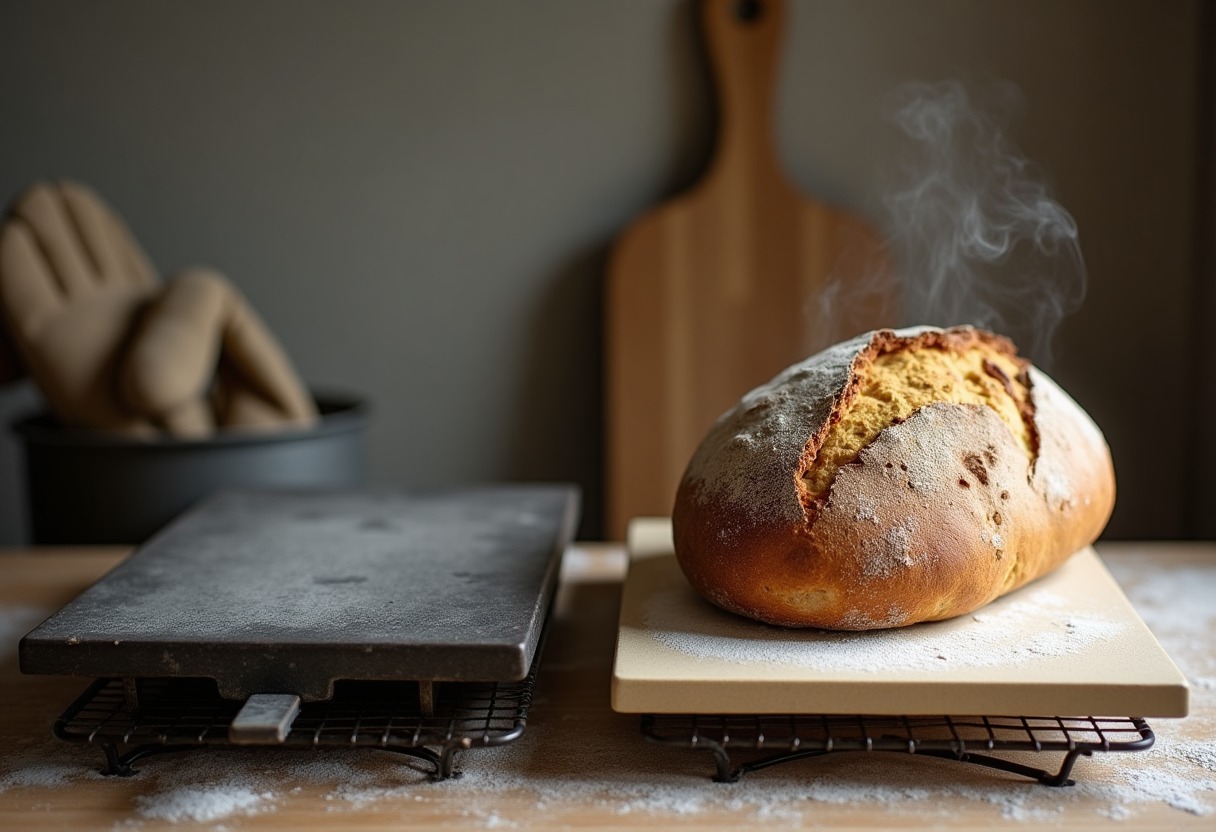
Your oven spring stalls halfway through the first ten minutes because your baking surface can't sustain the heat transfer your dough needs. The bottom crust sets before the loaf fully expands, and you're left with a dense crumb and pale base instead of the open structure you shaped so carefully.
Both baking stones and steels solve this problem, but they work in fundamentally different ways. Steel conducts heat roughly 18 times faster than ceramic stone, delivering an aggressive initial burst. Stone holds more total thermal mass and releases it gradually. The right choice depends on your dough hydration, oven type, and whether you're baking under a Dutch oven or directly on the surface.
How Baking Surfaces Transfer Heat to Sourdough
When cold dough contacts a preheated surface, heat flows from the surface into the dough at a rate determined by thermal conductivity. Steel's conductivity (around 50 W/mK) vastly exceeds cordierite stone (2-3 W/mK), creating rapid crust formation and aggressive oven spring in the first 3-5 minutes.
But conductivity alone doesn't determine performance. Thermal mass — the total heat energy stored in the material — matters equally. A 15-pound cordierite stone preheated to 500°F holds substantially more energy than a 16-pound steel at the same temperature because stone has higher specific heat capacity. This means stone sustains consistent heat transfer longer, especially valuable when baking multiple loaves in sequence.
The practical result: steel gives you explosive initial rise and dark bottom crust development. Stone provides steadier, more forgiving heat that's less likely to scorch high-hydration doughs. According to tests documented by Serious Eats, baking steels can reduce pizza baking time by 30% compared to stone — a similar principle applies to bread, though sourdough benefits from slightly gentler heat than Neapolitan pizza.
Cordierite Stones: Best for Dutch Oven Baking and High-Hydration Loaves
Cordierite baking stones excel as oven floor stabilizers when you're baking sourdough inside a Dutch oven. The stone absorbs heat fluctuations from the heating element cycling on and off, creating a more stable ambient temperature around your covered pot. This matters during the first 20 minutes of baking when steam is trapped and oven spring is most active.
A → Shop cordierite baking stone on Amazon typically measures ¾ inch thick and weighs 12-18 pounds depending on size. The thickness provides thermal mass without excessive weight. Cordierite specifically resists thermal shock better than other ceramics — you can move it from a 500°F oven to a cool countertop without cracking, though I still don't recommend it.
For sourdough baked directly on the stone (not in a Dutch oven), cordierite works best with doughs at 70-75% hydration. Higher hydrations tend to spread slightly before the bottom sets, and the gentler heat transfer from stone means you get good crust color without risk of burning. If you're working through the techniques in our Sourdough Shaping Techniques Complete Guide, a stone gives you a wider window to nail your shaping before baking.
Preheat cordierite for 45-60 minutes at your target baking temperature. The material heats slowly and needs time to saturate throughout. Place it on the middle or lower-middle rack — never directly on the oven floor where element proximity causes uneven heating.
Baking Steel: Maximum Oven Spring and Leopard-Spot Crusts
A baking steel — essentially a thick slab of food-grade steel — transfers heat so aggressively that dough begins setting within seconds of contact. This creates dramatic oven spring because the bottom firms up quickly while the top remains soft enough to expand. The result is taller loaves with more open crumb structure, assuming your bulk fermentation and shaping were solid.
The standard thickness is 3/8 inch, weighing around 16 pounds for a 14x16-inch surface. A → Shop 3/8 inch baking steel on Amazon will last indefinitely with minimal maintenance — just wipe clean and apply a thin oil coat occasionally to prevent surface rust.
Steel works exceptionally well for lower-hydration doughs (65-70%) where you want aggressive bottom heat to lift a tight boule. It's also ideal for achieving deep caramelization on the bottom crust — those dark leopard spots that signal proper Maillard reaction development. If your sourdough consistently comes out pale on the bottom even after full baking time, switching to steel usually solves it.
The downside: steel's aggressive heat can scorch wet doughs or loaves with sugar-rich inclusions. If you're baking a 78% hydration country loaf with your best bread flour, the bottom may blacken before the interior finishes. Counter this by positioning the steel on a higher rack or reducing oven temperature by 25°F after the first 15 minutes.
Preheat steel for 45-60 minutes, same as stone. Despite faster heat conduction, the mass still needs time to reach equilibrium.
Baking Stone vs Steel: Direct Comparison
| Factor | Cordierite Stone | Baking Steel | |------------|---------------------|------------------| | Heat conductivity | 2-3 W/mK — gradual, even transfer | 50 W/mK — rapid, aggressive transfer | | Thermal mass | Higher per pound; holds heat longer | Lower per pound; recovers faster between bakes | | Best for | High-hydration doughs, Dutch oven base, forgiving baking | Maximum oven spring, dark crusts, back-to-back bakes | | Preheat time | 45-60 minutes to full saturation | 45-60 minutes (faster conduction, but mass needs time) | | Durability | Can crack from extreme shock; handle carefully | Nearly indestructible; develops seasoning patina | | Bottom crust color | Medium-brown, even development | Deep brown to leopard-spotted | | Price range | $35-$70 for quality cordierite | $70-$120 for 3/8" steel |
The table shows why many bakers own both: stone as a workhorse for everyday baking and covered loaves, steel for when you want maximum performance or are baking pizza alongside your bread rotation.
Recommended Baking Surfaces for Sourdough
Rectangular baking stone (15x20 inches): A large format → Shop rectangular baking stone on Amazon accommodates two medium boules or a single large batard. The rectangular shape uses oven space more efficiently than round pizza stones. Look for ¾-inch thickness and verify it's cordierite or similar thermal-shock-resistant ceramic.
Bread baking stone (15-inch round): If you primarily bake round boules and want maximum thickness for heat retention, a → Shop bread baking stone 15 inch on Amazon offers the best balance. Round stones fit better in some ovens and are easier to handle when moving between storage and oven.
Professional baking steel (3/8-inch thick): The → Shop pizza steel baking steel on Amazon category includes various thicknesses, but 3/8 inch is the sweet spot for bread. Thinner steels (¼ inch) work for pizza but lack the thermal mass for sustained bread baking. Thicker (½ inch) versions cost significantly more for marginal benefit.
Dual-surface setup: Use a cordierite stone on the bottom rack as a heat stabilizer and place a steel on the middle rack as your baking surface. This combination delivers steel's aggressive bottom heat while stone moderates the overall oven environment. Particularly effective in electric ovens where element cycling creates temperature swings.
Cast iron alternative: If you already own a large cast iron griddle, it functions similarly to steel — slightly less conductive but comparable thermal mass. Season it well and preheat just like steel.
Advanced Techniques Most Guides Skip
Ice cube steam with steel: Steel's high conductivity creates localized hot spots where water contacts it. Instead of pouring water into a pan, try placing ice cubes directly on the steel's corners (not under the bread) 30 seconds before loading your loaf. They vaporize slower than poured water, creating sustained steam during the critical first minutes. This technique pairs well with the steam management approach in our Dutch oven guide.
Temperature stepping for stone: Preheat your cordierite stone at 500°F for the first 30 minutes, then reduce to your target baking temperature (usually 450-475°F) for the final 15 minutes. This charges the stone with maximum energy while preventing oven overshoot when you open the door to load bread. The surface temperature will be slightly higher than oven ambient, giving you better initial spring.
Parchment as a heat moderator: When baking wet dough on steel, use parchment paper as a slight insulator. It reduces conductivity by roughly 15-20%, preventing bottom scorching while still delivering significantly more heat than stone. Skip the parchment when you want maximum bottom crust development on lower-hydration doughs.
Off-center placement for uneven ovens: Most home ovens have hot spots, typically toward the back or sides near elements. If your loaves consistently brown unevenly, position your stone or steel off-center toward the cooler zone. The thermal mass will moderate the temperature gradient better than an empty rack. Rotate the loaf halfway through if necessary, though this releases steam.
Alternating surfaces by dough: Keep both stone and steel ready in your oven on different racks. Load wet, sticky doughs onto the stone; load tight, lower-hydration doughs onto the steel. This requires understanding your dough's hydration level but lets you optimize each bake without changing equipment.
FAQ
How long should I preheat a baking stone for sourdough? Preheat cordierite stones for 45-60 minutes at your target baking temperature. The material heats slowly and needs time for heat to penetrate the full thickness. Shorter preheats leave the center cooler, reducing effective thermal mass and causing uneven bottom crust development.
Can I use a pizza steel for sourdough bread? Yes — pizza steels work excellently for sourdough and often outperform stones for oven spring and crust color. The aggressive heat transfer creates dramatic rise in the first five minutes. Reduce oven temperature by 25°F if bottoms scorch, or use parchment paper as a slight insulator under wet doughs.
What thickness baking steel is best for bread? 3/8 inch delivers optimal performance for bread baking. Thinner steels (¼ inch) lack thermal mass for sustained heat during long bakes; thicker steels (½ inch) cost substantially more without meaningful improvement. Most professional bakers and serious home bakers standardize on 3/8-inch steel.
Do I need both a baking stone and steel? Not essential, but many bakers eventually acquire both. Stone works better under Dutch ovens and for high-hydration doughs; steel excels for maximum oven spring and direct baking. If choosing one, steel offers more versatility unless you exclusively bake under a Dutch oven, in which case stone is adequate.
Why does my sourdough burn on the bottom with a baking steel? Steel's high conductivity transfers heat aggressively, especially in ovens with bottom heating elements. Move the steel to a higher rack, reduce temperature by 25°F after initial oven spring, or use parchment paper to moderate heat transfer. High-sugar or enriched doughs burn fastest and may require stone instead.
Choose stone when you want forgiving, consistent heat that handles wet doughs gracefully; choose steel when you're chasing maximum oven spring and aren't afraid of a darker crust.
Some links on this page are affiliate links. We may earn a small commission if you purchase through them, at no extra cost to you.
As an Amazon Associate we earn from qualifying purchases. This article contains affiliate links; if you buy through them we may earn a small commission at no additional cost to you.